


March 2026 - Week 4 Edition
The Press Focuses on Gold’s Daily Moves – We Don’t
The Wall Street Journal continues to miss the big picture on gold by concentrating on significant daily moves, partly driven by speculators and hedge fund managers. The latest example came last Friday, March 20, in an article entitled “Selloff in Precious Metals Accelerates.”
To start, this is the third time in the last five months in which gold has fallen sharply, only to recover almost as fast after the decline. Investors who “bought on dips,” as we counseled each time, have made the right (and emotion-free) decision to “buy low.” Here are three buying opportunities since October:
- On October 20, 2025, gold peaked at $4,336 and fell 8.5% to $3,966 a week later before soaring to $5,000.
- On January 29, 2026, gold fell 13%, from $5,318 to $4,622 in three days but then soared back to $5,294.
- On March 2, 2026, gold fell 15%, from $5,294 to $4,482 last Friday, a third buying window in five months.
The Journal did not point out the value of “buying on dips” but they were on the right track about what caused the latest decline: Previous to the Iranian war, there were expectations of two interest rate cuts this year but now that has been reduced to just one rate cut. The Journal was also good enough to cite a recent comparison: “Traders saw a similar dynamic play out in 2022, when Russia’s invasion of Ukraine led to a surge in energy prices, fanning inflation. Gold fell for seven straight months between April and October.”
Gold was $1,827 at the start of 2022, so it is up about 150% since then and silver has risen by 200%.
Another example of short-term thinking by the Journal writers came on March 2 “Gold Hasn’t Proved Buffett Wrong,” when they printed a chart showing gold badly underperforming both the S&P 500 and Warren Buffett’s Berkshire Hathaway stock since 2011, prompting an infamous anti-gold rant by Buffett.
As we pointed out before, those who bash gold tend to start their gold chart on the highest possible gold “bubble” date in January 1980, when gold hit $850. The Journal did this again in their March 2 article, citing gold’s sideways motion from 1980 to early 2025 but their chart cited gold’s $1,900 peak in 2011.
There’s an old maxim that “charts don’t lie,” but those who want to prove a point often twist the long-term results in their favor. That’s why we came up with this poem to show how to draft a misleading chart:
If you want a dazzling CHART,
Let me choose the date to START …
… Or if you want to prove a TREND,
Let me choose the date we END.
The March 2 Journal article starts out by saying Warren Buffett once quipped that gold “gets dug out of the ground in Africa, or someplace. Then we melt it down, dig another hole, bury it again and pay people to stand around guarding it. It has no utility.” But Buffett first said that in a speech at Harvard in 1998, so if you chart gold vs. stocks since 1998, instead of 1980 or 2011, gold is the clear winner. Gold’s average price in 1998 was $294, so even after its recent correction to $4,500, gold is up 1430%, while the S&P 500 is up one-third as much - +480% - but invariably, anti-gold writers start gold charts in early 1980.
Bear in mind, we’re not trying to talk people out of owning good stocks, since gold is more of a currency hedge and portfolio stabilizer than a replacement for stocks. Gold has beaten every historic currency over time. Most past currencies were inflated out of existence and those that remain are off 90% or more to gold in our adult lifetimes, since the 1960s. Since gold is up 130-fold vs. the U.S. dollar since 1971, today’s dollar is worth less than a single 1971 penny, in gold terms. That’s a “gold medal” performance.
Why Gold Has Soared Since 2000 – and Especially Since 2020
Gold was flat, trading $250 to $300 per ounce, from 1998 to 2001, mostly because the federal government balanced the budget and the dollar was strong. In early 2001, the Congressional Budget Office (CBO) predicted we’d see budget surpluses forever and would pay off the entire national debt within a decade. The cumulative public debt was $5 trillion then and the CBO predicted $5.6 trillion in surpluses by 2011.
Instead, budget deficits in that 10-year period reached $6.1 trillion, since the CBO failed to anticipate 9/11, the new “War on Terror,” resulting in 20-year wars in Afghanistan and Iraq, plus a real estate bubble, financial crisis and big bank bailouts. This created $39 trillion in public debt by 2026. That’s the main reason why gold has grown about 17-fold, from $255 in 2001 to about $4,400 to $4,500 – runaway federal deficits.
The Wall Street Journal published a far more sensible gold article last week “To Hedge Against Risk, Wyoming Stockpiles Gold,” on March 17, 2026, by Jared Mitovich. This article begins by saying: “Wyoming bought gold in December after passing a law requiring the state’s investment portfolio to add precious metals as a hedge against economic turmoil.” This is a great example of the New Gold Standard!
But alas, the Fed threw cold water on both gold and stocks in their Federal Open Market Committee (FOMC) meeting last week (March 17-18), apparently spooked by the sudden rise in the Producer Price Index (PPI), rising 0.7% (8.5% annual rate) in February, with a 3.4% rise for the last 12 months. These numbers are before the escalation of war in Iran and the near doubling of crude oil prices. That will most likely show up in much larger March inflation totals, reported in mid-April
A Short Word on the “Gold/Silver” Ratio
Sometimes gold surpasses silver’s gains and sometimes silver shines, so we get questions on “what is the proper ratio” of gold to silver. Some cite historical ratios of 32-to-1 or even the mandated 16-1 ratio of the 1890s, when Western silver mining interests wanted to guarantee an unnaturally high price for silver.
It’s important to realize there is no “natural” or fixed ratio between metals or any commodities, including crude oil. Each market is subject to its own evolving formula of supply and demand.
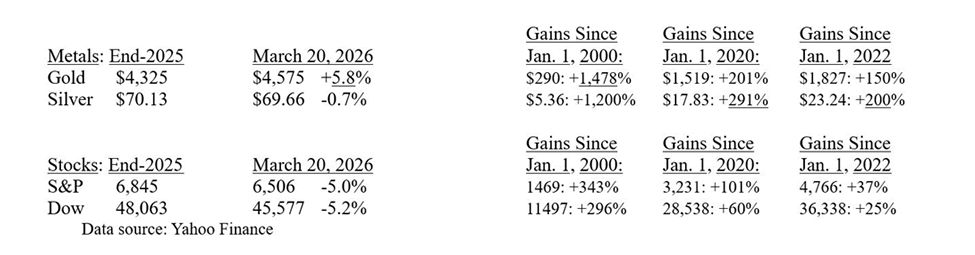
Gold dropped below $5,000 on news of the high rise (+0.7%) in the February Producer Price Index (PPI), indicating that the Fed will likely keep its key interest rates at a permanently high level (over 4%) for the time being. This is a short-sighted reaction, since gold has risen strongly in historical times of high interest rates but traders seldom study history, preferring a set of fixed “algorithms” for trading decisions.
The stock market also sold off over the inflation news, pushing major indexes below zero gains for the year, with the Dow down 5.2%, the S&P 500 down 5.0% and the Nasdaq down 6.9% through Friday, March 20.
Metals Market Report Archive >
Important Disclosure Notification: All statements, opinions, pricing, and ideas herein are believed to be reliable, truthful and accurate to the best of the Publisher's knowledge at this time. They are not guaranteed in any way by anybody and are subject to change over time. The Publisher disclaims and is not liable for any claims or losses which may be incurred by third parties while relying on information published herein. Individuals should not look at this publication as giving finance or investment advice or information for their individual suitability. All readers are advised to independently verify all representations made herein or by its representatives for your individual suitability before making your investment or collecting decisions. Arbitration: This company strives to handle customer complaint issues directly with customer in an expeditious manner. In the event an amicable resolution cannot be reached, you agree to accept binding arbitration. Any dispute, controversy, claim or disagreement arising out of or relating to transactions between you and this company shall be resolved by binding arbitration pursuant to the Federal Arbitration Act and conducted in Beaumont, Jefferson County, Texas. It is understood that the parties waive any right to a jury trial. Judgment upon the award rendered by the Arbitrator may be entered in any court having jurisdiction thereof. Reproduction or quotation of this newsletter is prohibited without written permission of the Publisher.