


March 2026 - Week 2 Edition
About a month ago, on February 13, 2026, with metals making headlines, the Wall Street Journal published an 8-question survey of how much its readers knew about the gold and silver markets. Some of the questions seemed irrelevant to us, so we thought we would draft a full 10-question quiz that reflects both the current market realities and some historical milestones in precious metals.
Please take this short test. The answers are below, after you make your best guess:
QUESTIONS ABOUT THE METALS MARKETS
Question #1: Through 2026, how many years in a row has silver run a supply deficit, meaning there is more annual demand for silver than new silver supply that year?
1: Two years
2: Four years
3: Six years
4: Eight years
Question #2: In which calendar year since 1980 did gold enjoy its best annual gain?
1: 2007
2: 2010
3: 2020
4: 2025
Question #3: In which calendar year since 1980 did silver enjoy its best annual gain?
1: 2009
2: 2010
3: 2020
4: 2025
Question #4: In what year did central bank gold buying suddenly double to 1,000 or more metric tons per year – and then stay at that level – signaling a major move into gold by central banks?
1: 2018
2: 2020
3: 2022
4: 2024
Question #5: Silver is historically more volatile than gold, in part due to silver’s smaller market size (the dollar value of its market). How much bigger is the gold market than the silver market?
1: Five times larger
2: 10 times larger
3: 15 times larger
4: 20 times larger
II. Some Historical Benchmarks
Question 6: When was a major gold deposit discovered in California, leading to the Gold Rush?
1: June 1846
2: January 1848
3: August 1848
4: September 1853
Question 7: At what national convention did Democratic candidate William Jennings Bryan deliver his “Cross of Gold” speech, earning his party’s presidential nomination?
1: 1892
2: 1896
3: 1900
4: 1908
Question 8: From 1970 to 1980, gold rose from $35 per ounce to a peak of … what?
1: $750
2: $850
3: $950
4: $995
Question 9: When did President Franklin D. Roosevelt revalue gold to $35 per ounce (from $20.67)?
1: 1933
2: 1934
3: 1940
4: 1945
Question 10: The American Gold Eagle debuted in what year?
1: 1976, at America’s Bicentennial
2: 1986, in the Reagan era
3: 1991, after Gulf War I
4: 2001, after 9/11
THE ANSWERS
Question 1, Answer 3 is right: 2026 marks the sixth consecutive year in which silver demand has outstripped supply. This shortfall began around 2021, driven by rising industrial demand, particularly in solar energy, electronics and AI, and boosted by recent Chinese trade embargoes.
Question 2, Answer 4 wins: Here are gold’s four best years since 1980, all in the last 20 years:
#1 is 2025 +64.5% (the best year by far)
#2 is 2007 +30.9%
#3 is 2010 +29.5%
#4 is 2024 +27.2%
Question 3, Answer 4: Here are the four best years for silver since 1980, all since 2009:
#1 is 2025 +142% (the best year by far)
#2 is 2010 +83.3%
#3 is 2009 +48.9%
#4 is 2020 +47.8%
Question 4, Answer 3: Central bank gold purchases topped 1,000 metric tons in 2022, doubling their historical average of less than 500 tons, and beating the previous record high of 650 tons.
Question 5, Answer 2: The gold market’s capitalization (dollar value) is approximately $30 trillion vs. only $3 trillion for silver, a 10-to-1 ratio
In the final five questions, answering “2” would be your lucky number
Question #6, Answer 2 is right, January 1848
Question #7, Answer 2 is right, June 1896
Question #8, Answer 2 is right, $850 (in January 1980, a 1-day bubble peak)
Question #9, Answer 2 is right, January 30, 1934, on the President’s birthday
Question #10, Answer 2 (1986) is once again right, during the Reagan era
How did you do?
** If you got 8, 9 or all 10 answers right, consider yourself a 24-karat gold bug.
** If you got 6 or 7 right, you are a second-tier jeweler’s apprentice, a 14-karat gold bug.
** If you got 4 or 5 right, you win a Bronze Medal for not knowing enough about gold and silver
** With 3 or fewer right, you fail, since you have a 25% chance of being right by wild guesses.
Keep reading this weekly Metals Report so that you can ace the next quiz, perhaps later this year.
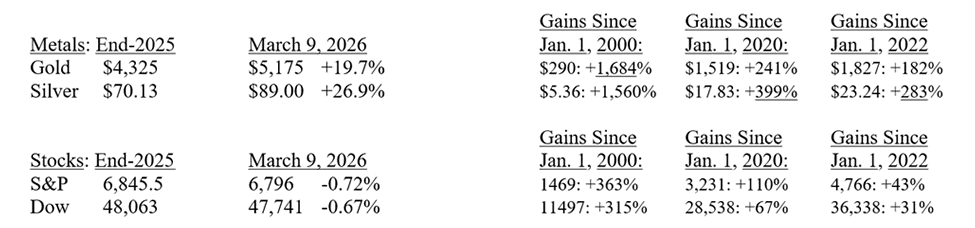
Gold has stayed above its $5,000 support level since February 20. After a small decline in early March, gold surged $100 on Monday, March 9, opening at $5,075 and closing $100 higher, at $5,175. Silver replicated that move with an even stronger surge, from a Monday opening of $83 to a close at $89. Gold is up nearly 20% for the year 2026 (and silver is up 27%), while the major stock market indexes are now in negative territory, down about 0.7%. Oil prices shot up to $119 at one point – more than double oil’s December price level – but then began to drop as it was made public how the U.S. military would help protect ships in the Strait of Hormuz, which is seeing traffic increase.
Metals Market Report Archive >
Important Disclosure Notification: All statements, opinions, pricing, and ideas herein are believed to be reliable, truthful and accurate to the best of the Publisher's knowledge at this time. They are not guaranteed in any way by anybody and are subject to change over time. The Publisher disclaims and is not liable for any claims or losses which may be incurred by third parties while relying on information published herein. Individuals should not look at this publication as giving finance or investment advice or information for their individual suitability. All readers are advised to independently verify all representations made herein or by its representatives for your individual suitability before making your investment or collecting decisions. Arbitration: This company strives to handle customer complaint issues directly with customer in an expeditious manner. In the event an amicable resolution cannot be reached, you agree to accept binding arbitration. Any dispute, controversy, claim or disagreement arising out of or relating to transactions between you and this company shall be resolved by binding arbitration pursuant to the Federal Arbitration Act and conducted in Beaumont, Jefferson County, Texas. It is understood that the parties waive any right to a jury trial. Judgment upon the award rendered by the Arbitrator may be entered in any court having jurisdiction thereof. Reproduction or quotation of this newsletter is prohibited without written permission of the Publisher.